

Lionfish in Curaçao: why we hunt it, and how we eat it
The lionfish in Curaçao is an invasive species: native to the Indo-Pacific, it has no natural enemy in the Caribbean and devours the reef’s young fish. That is why divers hunt it, within a strictly regulated framework. Its fine white flesh then ends up on the plate.
The Little Green Boat is a French and English speaking dive centre in Curaçao. Your dives run in English or in French with the whole team, whichever you prefer, and Fabien also guides in Spanish. We run our lionfish control missions from the shore.
Beautiful, but in the wrong place
First, a common belief: such a spectacular fish should surely be protected. Quite the opposite. The lionfish is stunning to look at, but it is a predator with a huge appetite. According to the US ocean agency NOAA, whose fact sheet was updated in September 2026, it eats more than 50 species of fish. Among them is the parrotfish, which grazes the algae on the reef.
Second, it comes from the Indo-Pacific. In the Caribbean, however, it has no natural enemy. A single fish can therefore wipe out young reef fish at an alarming rate. As a result, every lionfish removed gives corals, sponges and local fish a better chance.
Lionfish in Curaçao, a danger for divers too
Its fins carry venomous spines. According to NOAA, a sting can cause extreme pain for several days, with sweating and breathing difficulties. So never touch it with bare hands, neither underwater nor when preparing it.
A strictly regulated hunt
In Curaçao, lionfish hunting is strictly regulated. Do not turn yourself into a hunter during an unguided dive. Instead, join a supervised dive, where the instructor handles the specialised equipment and shows you the safety techniques.
How a lionfish hunt in Curaçao works
Our Predator Patrol dive always follows the same steps:
- The briefing. Why the lionfish is invasive, its impact on Curaçao’s reefs, and how divers help restore the balance.
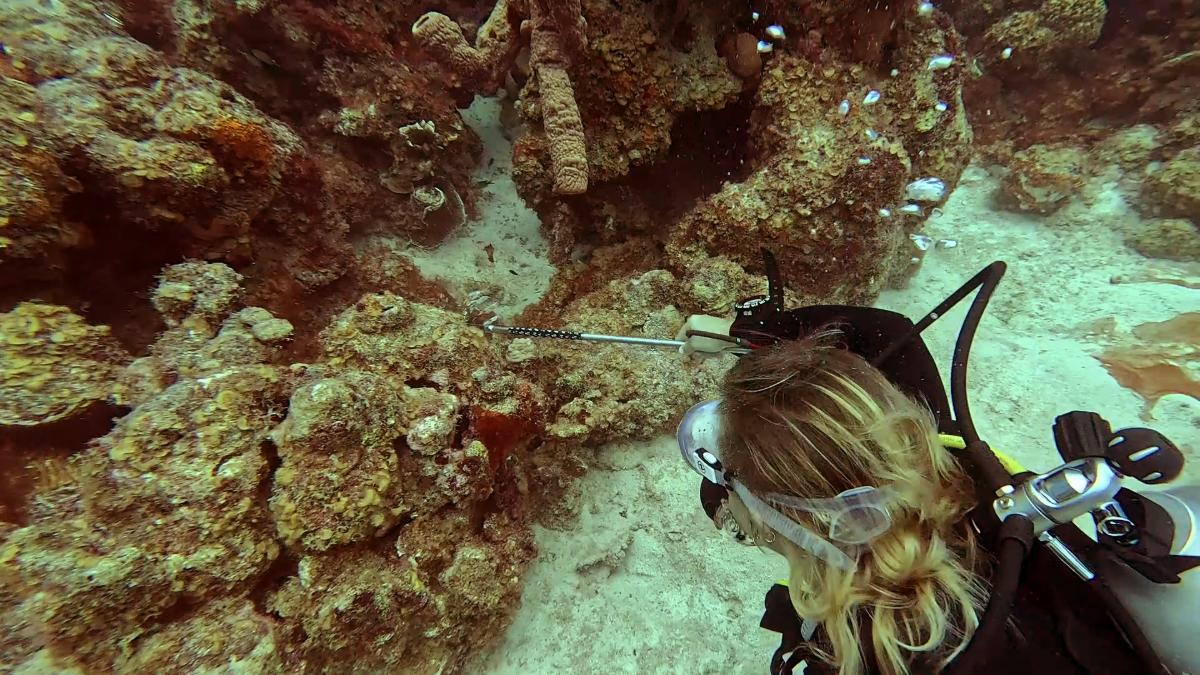
- The equipment. You learn to handle a pole spear safely. You also practise approach techniques.
- The guided dive. You look for lionfish in their usual hiding places, often deep in the coral and rocks.
- The collection. The catch goes into a secure container, the Zookeeper, which we provide. It protects both the reef and you.
- The debrief. You then receive a personalised dive report, with our observations and photos.
The level required
Good buoyancy is essential. Indeed, you handle a pole spear and a Zookeeper at the same time, close to the coral. For this reason, we require the Advanced Open Water certification. If you do not have it yet, our Advanced Adventurer course prepares you for it.
Where we hunt lionfish in Curaçao
We run our control missions at Playa San Juan, a private estate where lionfish are very common. The site is described in our guide to the best dive sites in Curaçao.
And then, we eat it
Nothing goes to waste. After the dive, we show you how to remove the venomous spines safely. Then the fish are prepared to be eaten locally.
Its flesh is white and delicate, very close to grouper. In fact, it is the first fish in our selection of seafood restaurants in Curaçao. On the island, the go-to address is Lionfish Caribbean. They even turn the spines into jewellery. Ordering lionfish at a restaurant is therefore the simplest way to help the reef, even without diving.
Our approach
Hunting in a large group is ineffective and, above all, dangerous. Our dives are therefore private, for a minimum of 2 divers, with an instructor dedicated to your pair or your family. The price is $90 per person, or 162 XCG, from the shore. A second dive on the same day costs $120, or 216 XCG. Finally, equipment is included, or a $20 discount applies if you bring your own.
Would you rather watch than hunt? Our other private dives for certified divers also start from the shore, and our guide to eco-responsible diving explains our rules underwater.