


Swim with turtles in Curaçao: where, when and how to do it right
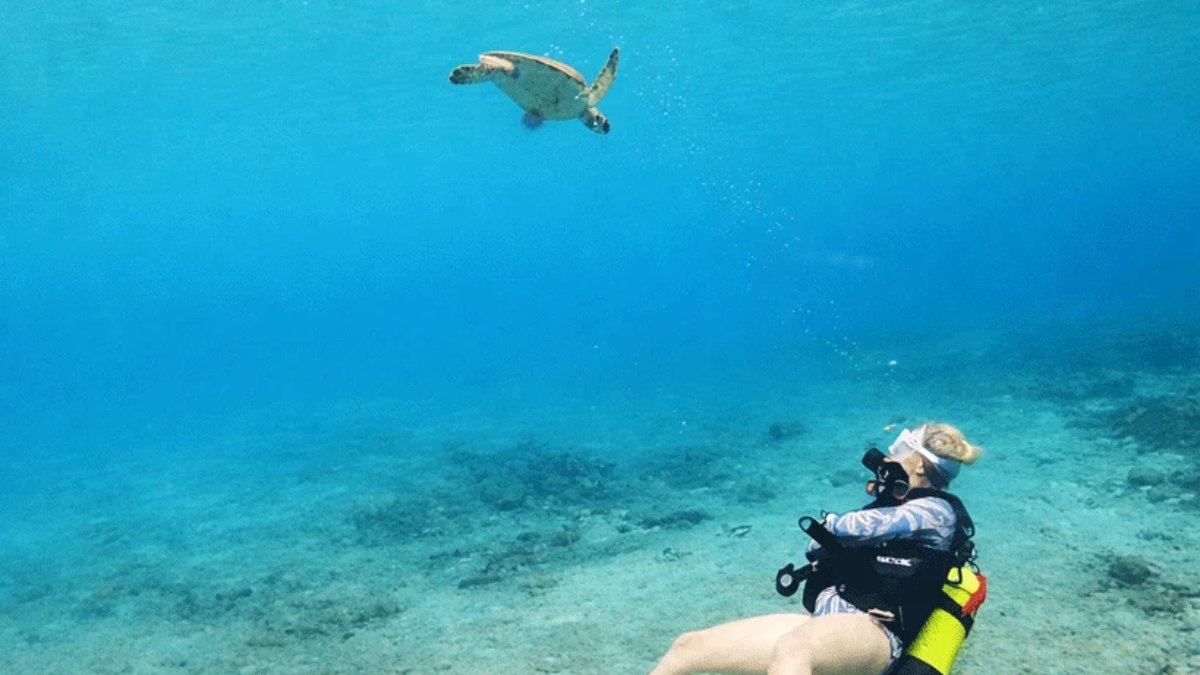
You can swim with turtles in Curaçao pretty much all year round, over the shallow reefs and seagrass beds that ring the island. The green turtles here graze on their own terms: nobody feeds them and nothing is staged. The most famous turtle beach, Playa Piskadó, is also the one we steer people away from. Here is why, and where to go instead.
The Little Green Boat is a French and English speaking dive centre in Curaçao. Your dives run in English or in French, whichever you prefer, with a dedicated instructor who speaks both.
The usual advice: “just go to Playa Piskadó”
Almost every guidebook points you to the same place. Playa Piskadó, also known as Playa Grandi, lies at Westpunt on the far western tip of the island, and yes, turtles gather there in numbers. The reason is less romantic than it looks. Local fishermen clean their catch on the beach and toss the scraps into the water, and the turtles have learned to wait for them.
So what you see there is not a natural encounter. It is, in effect, a feeding station. It makes for a great photo, but it tells you very little about how a green turtle actually lives out on a seagrass bed.
Why we don’t take guests there
Our position is simple, and it almost certainly costs us bookings: we never take anyone to swim with turtles on a feeding site. First, artificial feeding disrupts the way turtles forage. Second, it gives them a diet that isn’t theirs. Third, crowding animals around fishing waste raises the risk of entanglement. All three points are made by the Stop Feeding Turtles in Curaçao campaign, covered by the local diving site Dive Curaçao.
On top of that, the crowds are a problem in their own right: lots of people, not much space, and animals that have grown used to being touched. On every outing we do the opposite. No feeding, no chasing, no crowding around an animal. It is a core part of our approach to eco-responsible diving.
Where to see turtles in Curaçao instead
Turtles don’t live on one beach. They feed on seagrass and rest along the edges of the reef, and those habitats run right around the island. That is why we pick the site on the morning itself, depending on the swell, the wind and the visibility.
From the shore, in a small group
Most of our turtle dives start straight from the shore. It is calmer and far more flexible: there is no boat schedule, so we can take our time and stay over the same patch for as long as it makes sense. If you have never dived before, our Turtle Spotter introductory dive costs 103 USD (185 XCG) per person, and a second dive the same day is 138 USD (249 XCG). Full equipment, water and fruit are included. Groups are 2 divers minimum and 4 maximum, and the minimum age is 10.
If you are already certified
Open Water divers and above join the Turtle Tracker dive instead. It costs 90 USD (162 XCG) per person, or 120 USD (216 XCG) for a second dive the same day, with 20 USD off if you bring your own gear. The dive is fully private, from 2 divers upwards. Not certified yet? Our diving courses will get you to Open Water level while you are on the island.
How we choose the sites
We deliberately don’t publish a list of “turtle spots”. Once a site gets heavily advertised, it tends to get damaged. That said, our guide to the best dive sites in Curaçao covers the main areas of the island. And if you plan to shore dive without a guide, read our shore diving safety tips before you go.
When to go: what the seasons change for turtles in Curaçao
Green turtles are on the seagrass beds all year, so the season mostly matters for something else: nesting. According to Shete Boka National Park, three species currently nest on Curaçao: the hawksbill, the loggerhead and the green turtle. Leatherbacks no longer nest on the island. The nesting season runs roughly from May to December, and the nests are monitored by researchers from Carmabi.
One thing we will always be upfront about: we never promise an encounter. No serious dive centre can, unless it feeds the animals. Some days we see several turtles on a single dive. Other days, none at all. That is the price of watching wildlife that is actually wild.
Our approach at The Little Green Boat
Fabien Thepot and Caro lead every outing themselves. Both are PADI and SSI certified diving instructors with more than 5,000 dives each, and they keep groups deliberately small.
Every turtle dive also doubles as a survey. We log where each turtle was, how it behaved and any visible signs of health, then pass the data on to Sea Turtle Conservation Curaçao. You also get a personal report of your dive, with our photos. Want to know who you will be diving with? Our about page tells the full story.
Three rules for swimming with turtles without disturbing them
First, stay at least three metres away. Second, never touch a turtle, not even with a fingertip. Third, always leave it a clear path to the surface, because a turtle needs to breathe when it decides to. Those three habits alone make the encounter far better, for you and for the turtle.